
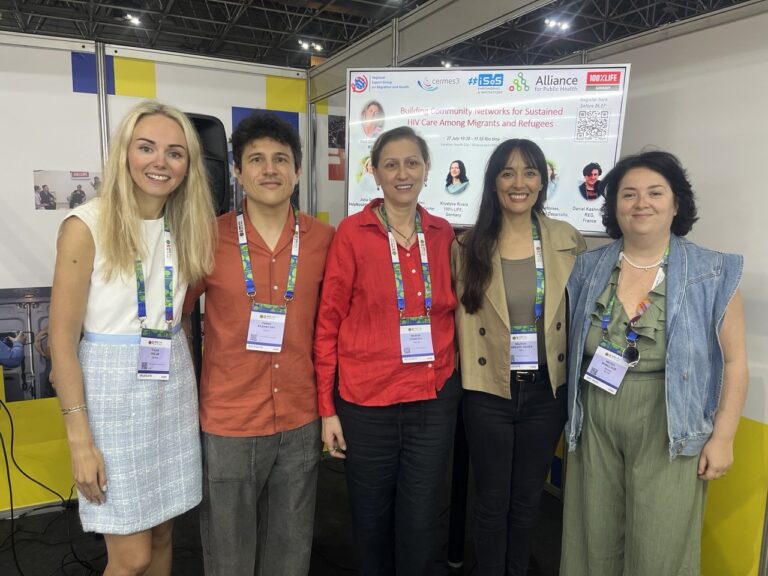
On 27 July, during AIDS 2026 in Rio de Janeiro, a discussion titled “Building Community Networks for Sustained HIV Care Among Migrants and Refugees” took place at the Ukraine Resilience Booth.
The event was held as part of the work of the Regional Expert Group on Migration and Health in Eurasia (REG). The discussion was moderated by Daniel Kashnitsky and Mari Chokheli.
The central question of the session was highly practical: how can we ensure that people who are forced to move because of war, crisis, persecution or economic instability do not lose access to HIV treatment, prevention, information and support?
For people living with HIV or people with a higher likelihood of acquiring HIV, migration often means much more than moving to another country. It means a new health system, a different language, unclear rules, documents, fear of stigma, lack of money, loss of trusted contacts and the risk of being left alone with questions that directly affect their health.
This is why continuity of HIV care in the context of migration cannot be built around a health facility alone. It requires a network: people, organisations, services, counsellors, communities and clear referral pathways that help a person avoid getting lost between systems.
Yulia Golub, Coordinator of the HelpNow Service at HelpNowHUB Foundation and IAS HIV Prevention Ambassador, took part in the discussion. In her remarks, she spoke about the experience of HelpNowHUB — an initiative that emerged as an emergency response to the full-scale war against Ukraine and later became an independent foundation supporting people on the move.
“For a person in migration, HIV care is not one service in one place. It is a pathway: information, trust, documents, referrals, language support and continued accompaniment. If even one part of this pathway disappears, a person may fall out of treatment or prevention,” said Yulia.
According to her, the war only made more visible what had already existed before: health systems often remain fragmented, difficult to navigate and not always ready to respond to the needs of people moving across countries.
For Ukrainians who have found themselves in other countries because of the war, access to HIV care often starts not with a medical protocol, but with very simple and at the same time very difficult questions: where to go, whether documents will be accepted, how to explain one’s status in another language, whether confidentiality will be protected, whether treatment can be accessed without judgement, and whether there is someone nearby who can help navigate this path.
This is where communities play a key role.
“Community networks are not an add-on to the system. For many migrants and refugees, they are the first real pathway back to care. A person often does not start with a doctor or a public service. They start with someone they can trust,” Yulia emphasised.
Participants stressed that the resilience of HIV care during crises depends not only on the availability of medicines, but also on whether there are functioning mechanisms of cooperation between countries and organisations. This includes clear referrals, accessible information in several languages, peer counsellor support, sustainable partnerships, flexible services and the meaningful involvement of communities in decision-making.
“The crisis has shown that continuity of HIV care is sustained not only by protocols. It is sustained by trust between people, by communities that do not let a person disappear at the moment of movement, and by community organisations such as HelpNowHUB, which allow care to move together with the person,” said Yulia.