
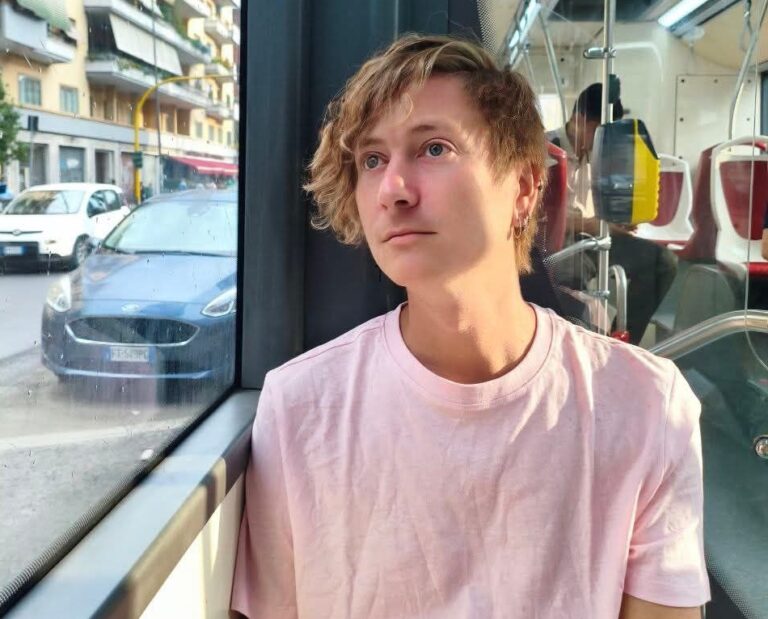
When we talk about forced migration, the word “adaptation” comes up a lot. But behind it are very specific things: electricity, internet, work, safety, the ability to stay useful, and to keep in touch with Ukraine. Oleh Zaitsev is the HelpNow HUB representative in Kraków and a two-time internally displaced person who has traveled the road from Luhansk to the Kyiv region and later to Poland. He has worked for many years in the social sector and in HIV services, and today he helps the Ukrainian community abroad navigate support systems and avoid being left alone with barriers.
We spoke with Oleh about two displacements, choosing Kraków, working during blackouts, barriers migrants face in Poland, and what matters most for someone who has just learned their HIV status.
— Oleh, could you briefly tell us where you’re from, how you ended up in Poland, when, and why Kraków?
— First of all, I’ve been an IDP twice. I’m originally from Luhansk, so this is my second displacement.
I came to Poland at the end of 2022—during the first major blackouts in Ukraine. I was living near Kyiv and working on Ukrainian contracts. When the power went out, mobile service and the internet went out with it—basically everything. And with a private house, if there’s no electricity, there’s no heating, water, or sewage either. I had to keep working, and that became the key reason for moving.
Why Kraków? Because it’s the closest large city to Ukraine. I often needed to travel to Ukraine for work, and in 2022 the connections weren’t as well organized yet. Warsaw is far, while Kraków was the best logistical choice.
— You mentioned you’ve been displaced twice. How did your first internal displacement happen?
— It happened gradually. Back in 2013, I started traveling, looking around, searching for work in Kyiv. And in 2014, when everything became clear, the decision was finalized: I would live in territory controlled by Ukraine. That’s when I made the final move to Kyiv.
That was also when I began working in HIV services.
— Did you have experience in the civic sector before that?
— Yes. My first experience in NGOs was back in 2004—at a Luhansk regional children’s community organization. Then came another major chapter: I worked in children’s camps for more than 10 years, and for six years I worked at a school.
— In what role?
— A school activities coordinator. Today they’d call it an event manager. (smiles)
— When you moved to Kraków, how did adaptation go? What surprised you?
— The move came with a feeling of “temporariness.” We agreed with the landlady on a six-month lease—and throughout that time we lived with the thought: “tomorrow we pack up and go home.” Because of that, I didn’t learn the language, and I didn’t build long-term plans—as if you’re not really here, just “on pause.”
— At that time, were you still working with the NGO “100% Life”?
— Yes, I continued. But one project ended in June 2024. Then there was another one—related to supplying and distributing kits to healthcare facilities and residential institutions. That project ended on March 31, 2025.
After that, there was a pause, and now I have several projects in Ukraine—both humanitarian and social. In parallel, I’m developing my work here in Poland.
— Was there a period when you traveled a lot between Poland and Ukraine?
— Yes. In one of the projects, my task was to travel and check distribution points: how aid was stored and how it was distributed. In six months, I visited around ten regions—from Sumy to Volyn.
It was an exhausting rhythm: 28 days in Ukraine, then back to Poland, then 28 days in Ukraine again. At first it was manageable, but later you catch yourself waking up and not understanding where you are.
— You’ve worked in the social sector for a long time. Why work with key populations and HIV services specifically?
— In 2014, I was rather accidentally invited to try HIV services. I started as a social worker at a community center in Kyiv. Then it grew from there: training, new tasks, different roles. There was a period when I worked outside HIV services but still in NGOs—and later I returned, already in the central office of “100% Life.”
I like that it’s a broad field: development, advocacy, community work, many directions. And it’s always people—communication, new connections. Especially now, when we’ve been scattered across the world, that sense of network and mutual support is particularly valuable.
— From your experience: what barriers do migrants most often face in Poland, and how can they overcome them?
— In Poland, the key barriers are language and legislation. My advice is simple: look for organizations that understand the field and can guide you correctly. There are truly many organizations in Poland, and what’s important—information about HIV testing can even be seen in Ukrainian on public transport; there are announcements and voice messages. So “entry points” do exist—it’s important to use them.
If we talk about internal displacement within Ukraine, one of the first challenges is finding an infectious disease doctor in the city you arrive in. Plus access to medication and understanding where things are available, because the situation changes and it’s hard to “track” consistently.
— And what would you advise someone who has just learned their HIV status? How can they get through the acceptance stage?
— First, it’s important to remember: everyone reacts differently. But my basic recommendation is to reach out to a psychologist. And second, to find peer-support groups—the “peer-to-peer” community. Even if there is no psychologist, real people who live with it are a huge support.
It’s also important to have “your people” nearby—friends, loved ones, relatives who don’t dismiss you and aren’t afraid. Without support, it’s much harder to get through it.
— You raise the issue of stigma and prejudice. What do Ukrainians encounter in Poland?
— Sometimes it hurts to hear the narrative that “Ukrainians brought an epidemic.” It’s bitter, because in reality a lot depends on testing: if there’s little testing, there’s little detection. That’s how it works everywhere.
There’s another point: in Poland, testing isn’t always offered automatically—sometimes you have to insist and ask. Without that, the problem becomes “invisible,” and then myths and accusations are easily born.
— What are your professional and personal plans for the coming year?
— Professionally, I want to better understand how Poland’s healthcare system works, how the sector and foundations operate, and how rules and processes differ. I want to understand the system better so I can provide higher-quality consultations.
Personally, I want more stability and a clearer sense of “rooting” here. Right now, there’s a lot of mixed environments, different communities, many overlapping processes. And I want to be effective in my new role—as a consultant and as the HelpNow HUB representative in Kraków.
***
This publication was prepared within the framework of the project “From heart to heart” in partnership with Step by Step Fundacja, with financial support from the Elton John AIDS Foundation.